
Learn Noorani Qaida Online with a Patient 1-to-1 Tutor
The first step towards reading the Quran is Noorani Qaida. Our Qaida lessons for kids combine play, repetition and short, interactive activities with a patient tutor, so every child can learn at their own speed and enjoy each lesson. Our online 1-on-1 Noorani Qaida classes for kids help toddlers, kindergarten children and older beginners learn the Arabic alphabet, Makhraj and basic Tajweed before they open the Quran.
- Children from age 4 can start, and older beginners are always welcome
- Private 1-on-1 online Quran classes with a male or female Noorani Qaida teacher
- Relaxed, fun activities using digital whiteboards, flashcards, games and rewards
- A free trial class, so your child can meet the Quran teacher before you sign up
Noorani Qaida for Adults and Reverts
Noorani Qaida isn’t only for children. Adults and new Muslims follow the same 17 lessons, usually in 2–4 months, with a tutor who explains every sound in English. See our Quran classes for adults.
Why Noorani Qaida Classes for Kids Matter
Noorani Qaida is the foundation of Quran reading. Before a learner can read the Quran with Tajweed, they need to know every Arabic letter, its sound and how it joins with other letters. Qaida lessons for kids teach exactly this, in a clear order that builds one skill on top of another.
Young children are natural imitators, which makes toddlers and kindergarten children ideal Quran learners. A child who starts early hears correct Arabic sounds, copies them and builds a love for the Quran before reading ever feels difficult. This course also builds focus and patience, two habits that help every later Quran lesson. That is why our Qaida course for kids is designed around listening, repeating and playing.
Who These Noorani Qaida lessons for Kids Are For
Our Qaida course is suitable for complete beginners, even very young children. There is no prerequisite. If your child can hold a tablet for a few minutes and mimic an Arabic sound, they are ready to start Noorani Qaida.
| Age | Lesson length | Focus | Typical pace |
|---|---|---|---|
| 9–12 months | 30 minutes | Letter sounds, songs, picture cards | Slow and playful |
| 6–9 months | 30 minutes | Letters, Harakat, first joining | 6–9 months |
| 4–6 months | 30 minutes | Joining, Tanween, Sukoon, Shaddah, reading words | 3–6 months |
- Ages 4–5: letter sounds, rhymes and picture cards, one letter at a time
- Ages 6–8: letters, Harakat and first joined words, with plenty of games
- Ages 9 and up: faster progress, with reading words independently and early Tajweed
Noorani Qaida Classes for Toddlers and Kindergarten Kids
Toddlers learn differently from older children, and every toddler needs a teacher who understands toddlers. Our Quran teachers keep 1-on-1 Noorani Qaida classes for toddlers short, colourful and full of movement. A toddler may spend five minutes on a song about one Arabic letter, then switch to a flashcard game, then trace the letter on a digital whiteboard.
For kindergarten children, Noorani Qaida classes add more structure. Kindergarten children begin to recognize Arabic letters in words, practise Makhraj with a mirror and start reading short words with Harakat. Our teachers adjust every class to the age and attention span of the child.
What Your Kid Will Learn in Noorani Qaida Classes for Kids
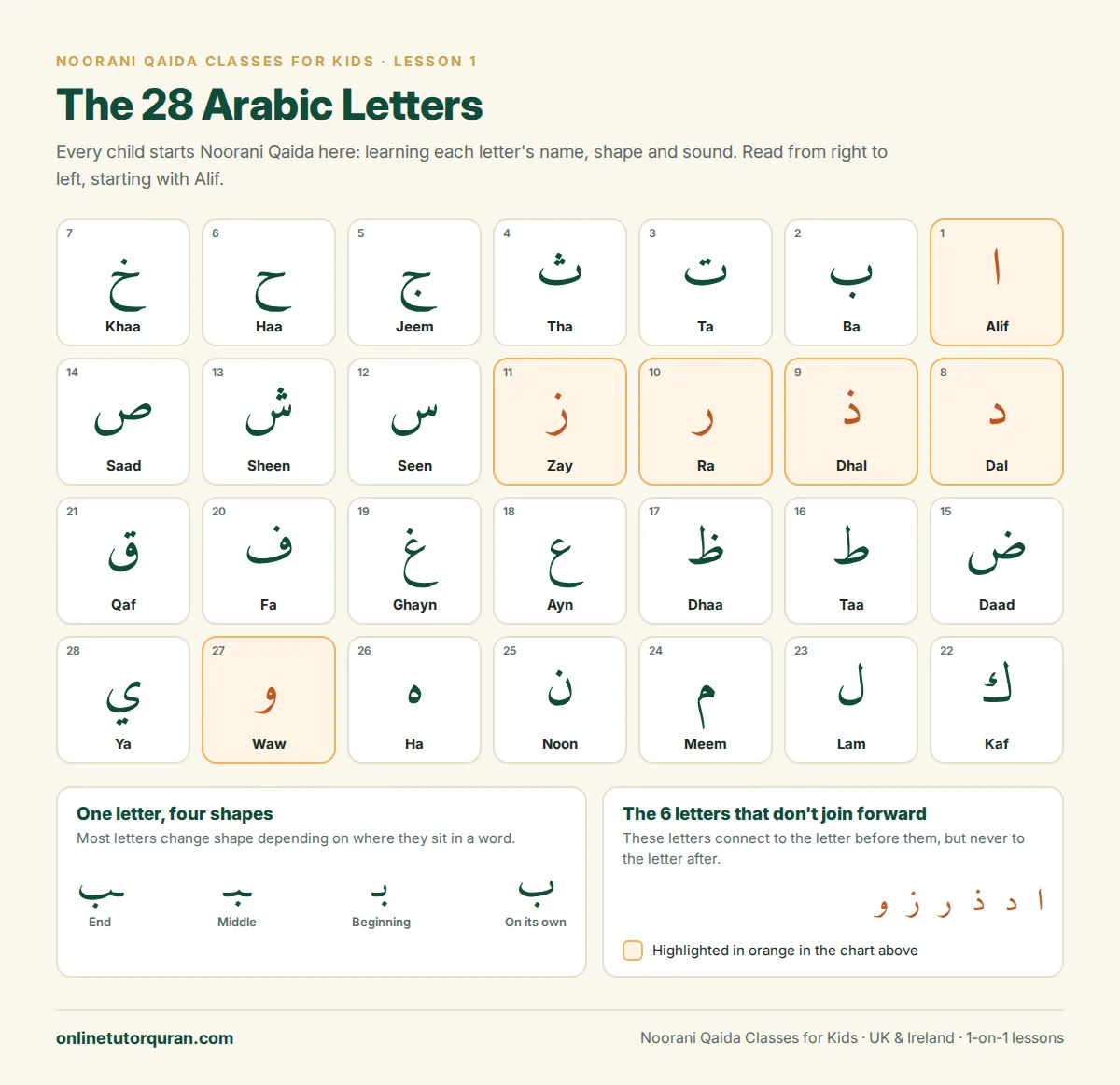
- All 28 Arabic letters with their names, shapes and correct pronunciation (Makhraj)
- Short vowels (Harakat: Fatha, Kasra, Damma) and how these vowels change each Arabic letter
- How Arabic letters change shape in isolated, initial, medial and final positions
- Long vowels (Madd), Sukoon, Shaddah and Tanween
- Basic Tajweed rules in small, simple steps
- Smooth and accurate reading of whole Arabic words, ready for the Quran
Our Three-Stage Noorani Qaida Path
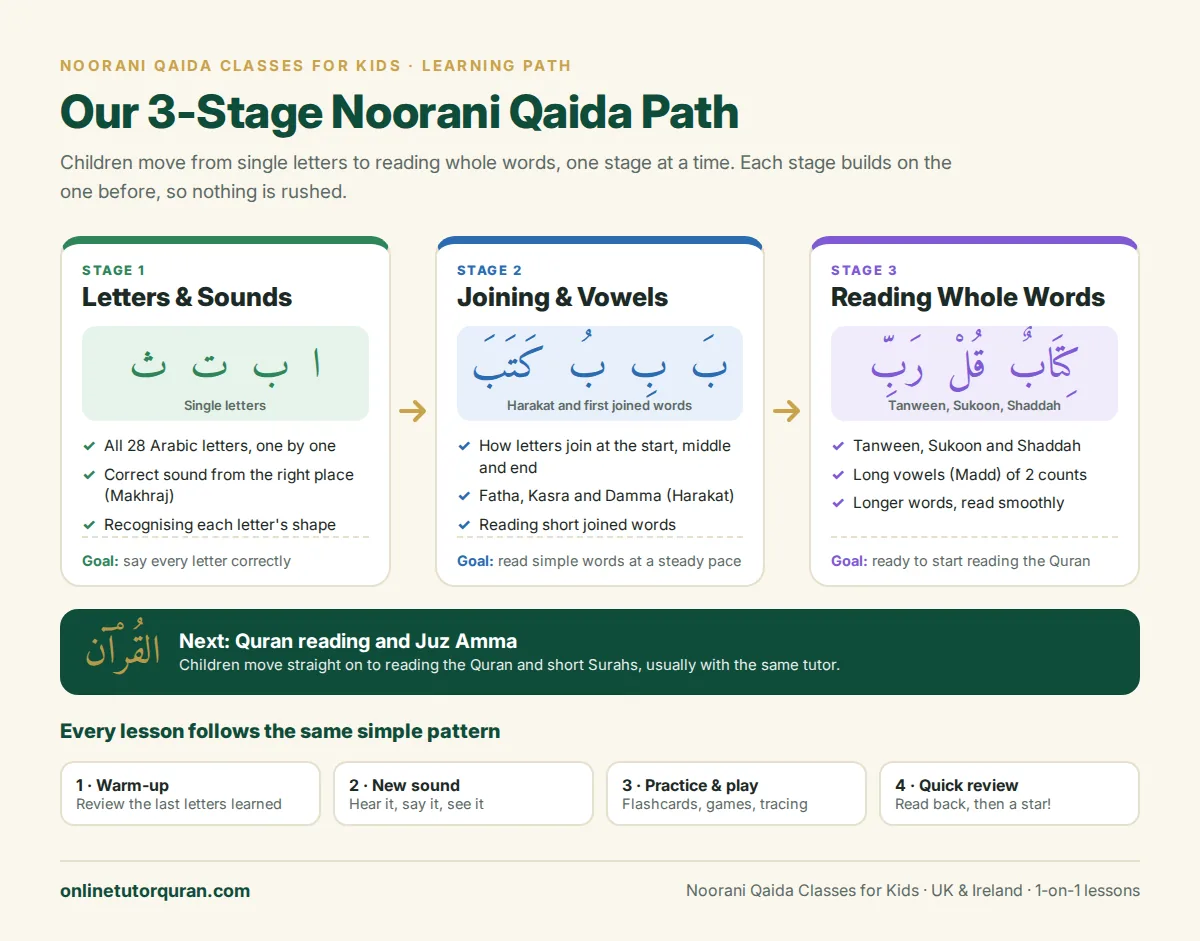
All learners progress in a consistent sequence: sounds, linking, reading. Progress depends on your child, not the calendar. How long it takes depends on age and practice. At three classes a week, children aged 6–8 usually finish in 6–9 months, children aged 9 and up in 4–6 months, and adults in 2–4 months.
Stage One: Letters and Sounds
- Meet all 28 individual Arabic letters, one by one
- Learn the Harakat: Fatha first, then Kasra and Damma
- Goal: each letter is said correctly, with Makhraj from the right part of the mouth or throat
Stage Two: Linking Letters and Vowels
- Learn how letters connect and change shape at the beginning, middle and end of a word
- Add vowel signs (Harakat) one after another
- Goal: the learner reads simple Arabic words at a steady pace, with correct Makhraj
Stage Three: Reading Whole Words
- Read short words, then longer words broken into syllables
- Meet Tanween and double vowel endings in Arabic words
- Goal: accuracy, Tajweed, flow, patience and enjoyment, ready to start reading the Quran slowly
Inside the Noorani Qaida Curriculum
Sound Placement (Makharij)
The source of a sound decides how it sounds. Learners practise throat, tongue and lip letters in groups, hold a hand to their throat to feel the vibration and look into a mirror to see their mouth. Our teachers never rush Makhraj, because correct Tajweed begins with correct Makhraj.
Short Vowels (Harakat)
One vowel is introduced each session so that each Arabic letter learns to “speak” in three voices (a, i, u). Most learners are blending letters and Harakat into short words by week three.
Letter Shapes and Joining
Most Arabic letters have different forms in isolated, initial, medial and final positions. In this course we teach these forms of an Arabic letter as one letter in different outfits, not as new letters. Six letters (Alif, Dal, Dhal, Ra, Zay and Waw) do not join forward, and we practise this rule with songs and colourful charts.
Tanween, Sukoon, Shaddah and Madd
- Tanween: the doubled vowel marks that add an “n” sound at the end of a word
- Sukoon: a short, measured pause without a vowel
- Shaddah: a gentle “press” that doubles a sound
- Madd: a stretch of two counts (long vowels), introduced once reading is steady
Short Surahs and Duas
When learners feel comfortable reading letters, they start learning short Surahs from Juz Amma, with simple Tajweed, and duas for eating, sleeping and leaving home. The move from Noorani Qaida to the Quran is easy and never abrupt.
Our Teaching Approach
Every Qaida lesson here follows the same simple pattern: warm-up, new sound, practice and play, then a short review.
Private 1-on-1 Noorani Qaida Lessons
Private 1-on-1 lessons mean quicker corrections from the teacher, no audience and a pace that belongs entirely to your child. Shy children open up earlier, and each lesson builds on the previous one. Group classes suit older children who already know their letters, but we recommend private classes for every beginner.
Built for Toddlers and Tiny Learners
- Quran sessions of 10 to 20 minutes for toddlers and tiny learners, growing longer with age
- Songs, puppets, picture cards, flashcards and colour-coded Arabic letters
- Two to three Quran classes per week with the same teacher to build trust
- Gentle Tajweed correction, one thing at a time
Learning Through Games
Repetition turns into play with flashcards, letter bingo, matching pairs, sound hunts and picture quizzes. Rewards such as stars, stickers and short songs keep motivation high, so young learners want to come back to the next Noorani Qaida class.
Your Online Noorani Qaida Classroom
- Interactive whiteboard: the instructor and child write and draw together
- Screen sharing: the instructor shows the page, and the child points and reads
- Live practice: the child reads aloud while the instructor follows and corrects
- Parent friendly: parents can sit in and watch any class
- Feedback: the instructor shares a short note on your child’s progress after every class
Our Online Noorani Qaida Tutors
Our Quran tutors are screened, trained and experienced with young children and toddlers. Many are qualified in Tajweed and Qiraat, and we provide both male and female Quran tutors for 1-on-1 Noorani Qaida lessons. Students are matched with a tutor by personality as well as timetable.
- 13 certified Quran tutors, so you will find a teacher who fits your schedule
- A patient, calm teaching style with gentle Makhraj and Tajweed correction
- Knowledge of Tajweed and experience with toddlers, kindergarten children and early learners
- Missed classes can be Reschedule free with 24 hours notice
Benefits of Noorani Qaida Classes for Kids Online
Learning Noorani Qaida online lets your child take Quran classes from home, with no travel and a schedule that fits school and family life. Children learn in a familiar place, which helps toddlers and shy children feel safe. Online 1-on-1 Qaida lessons for kids also give parents more control: you can watch any lesson and hear exactly what your child practised.
Digital tools make Arabic letters and Makhraj easier to remember in the Qaida. Colour-coded charts, flashcards, whiteboards and games help children connect each letter to its sound and Harakat. A good online Qaida class feels like play, yet every activity has one clear purpose.
Online Quran Classes for Kids: From Noorani Qaida to the Quran
Noorani Qaida is the first stage of learning the Quran. When your child can read short words with Harakat, the same tutor moves them on to Quran reading in our online Quran classes for kids.
How Parents Can Help in Noorani Qaida Classes for Kids
Parents play a big part in this journey, and children learn faster when a parent is involved. Short, regular practice works better than long, occasional sessions.
- Set a short daily routine, even five to ten minutes of Qaida, Makhraj and flashcard revision
- Ask your child to teach you the letter they learned in class
- Praise effort, not just correct answers
- Keep a quiet corner and a stable connection ready before every online class
- Ask your tutor what to practise next and go over it with your child
Flexible Scheduling
Qaida lessons should fit your family’s day, so book a free trial class at a time that suits you. Share your preferred time window and we will schedule a 1-on-1 slot around it. Mornings and weekends work best for young children, and families can choose local hours in any time zone. You can reschedule a Noorani Qaida class with a day’s notice and no penalty.
Families across the UK and Ireland, from London, Birmingham and Manchester to Dublin and Cork, book after-school and weekend Qaida lessons in their own time zone.
What Comes Next After Noorani Qaida Classes
This course is a doorway, not a destination. After this course, children can continue seamlessly with Quran reading classes, Online Tajweed Course, which means reciting the Quran with care, and Quran Memorization Course (Hifdh), which means reciting from the heart.
Before You Enroll in Noorani Qaida Classes for Kids
- Device: any laptop, tablet or computer that runs our online platform
- Internet: a stable connection and a quiet corner
- Materials: your tutor shares the Qaida pages on screen during class. A printed Noorani Qaida is helpful for practice at home but isn’t required.
- Level: a short conversation with the instructor places your child at the right level
- book a free trial class to test your device and meet the instructor first
- Plans start from £25/month for 2 classes a week, up to £45/month for 5 classes a week. Pricing
What Our Students/Parents Say
“My son has become much more confident with Arabic letters and pronunciation. His teacher is very patient and makes every class enjoyable.” Hannah R., Parent, Birmingham
“My daughter looks forward to her Noorani Qaida class every week. We have seen a noticeable improvement in her reading and pronunciation.” Omar K., Parent, Dublin
“The one-to-one classes are perfect for my child. The tutor explains everything clearly and gives us regular feedback on her progress.” Aisha M., Parent, London
Frequently Asked Questions (FAQs)
Noorani Qaida is a beginner's primer for reading the Quran correctly. It teaches the Arabic letters, their sounds (Makhraj), short and long vowels, and basic Tajweed, step by step, before a learner opens the Quran.
It was written by Noor Muhammad Haqqani, a scholar from Ludhiana, India. He designed it to help children and non-Arabic speakers learn Quran reading.
Yes. With a live tutor, a digital whiteboard and screen sharing, online lessons work as well as in-person ones. Children also learn from home with no travel.
It can be, as long as lessons are live and one-to-one. The tutor hears every sound and corrects Makhraj and Tajweed straight away. Recordings and a parent dashboard also let you review each lesson
The most common edition has 17 lessons, moving from single letters to joined letters, vowels, Tanween, Sukoon, Shaddah and Madd. Some editions group them differently.
Noorani Qaida is phonics-first, so learners practise sounds and then join letters into words. Baghdadi Qaida is older and teaches letter names first. Most modern Quran teachers prefer Noorani Qaida for beginners.
Yes. Adult beginners and reverts use it often. Adults tend to move faster, but the same steps apply, and the course is never "too late" to start.
No. Noorani Qaida starts from zero, so no prior Arabic or Quran reading is needed.
You need a laptop, tablet or computer, a stable internet connection and a quiet corner. No books are needed, because we provide a digital Qaida, flashcards and worksheets.
All 28 Arabic letters and their Makhraj, Fatha, Kasra and Damma, letter joining, Madd, Sukoon, Shaddah and Tanween, and basic Tajweed. By the end, they can read whole Arabic words and are ready for the Quran.
Two to three short classes a week with the same teacher works best for young children. Short, regular sessions beat one long weekend lesson.
Yes. We have male and female tutors, and we match each student by personality as well as schedule.
Fees depend on the number of classes per week and the plan you choose. Book a free trial first to meet the tutor, then you can pick the plan that suits your family. Plans start from £25 a month for 2 one-to-one classes a week, with 3, 4 and 5-day plans also available. Your first class is free, so your child can meet the tutor before you choose a plan.